

CSR in India Isn’t Just Lip Service — And Gautam Adani Is Actually Giving Us A Scorecard
Since 2013, Corporate Social Responsibility in India has operated as a legal system, not a branding exercise. The Companies Act mandates that firms with net worth above ₹500 crore, turnover above ₹1,000 crore, or profits above ₹5 crore must spend 2% of their three-year average net profit on social causes, under board supervision and public disclosure.
This has channelled over ₹80,000 crore into governed social spending. In FY 2023-24 alone, education received over ₹1,100 crore, while nutrition and healthcare absorbed ₹720 crore. What is widely misunderstood is that CSR is now outcome-driven.
The Adani Group exemplifies this shift by publishing “scorecards” that map funds to results: 7.3 million people reached across 5,753 villages in 19 states, 100,000 children educated, nearly 400,000 patients served annually. CSR here functions like a parallel balance sheet for social impact.
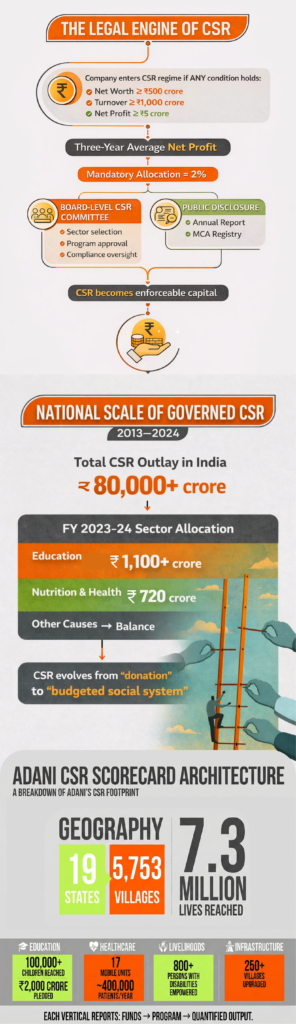
- CSR in India is no longer voluntary reputation management. It is a legally enforced capital flow tied to profits, boards, and public disclosure.
- Social spending now behaves like a second balance sheet, where outcomes – students, patients, villages – must be counted, not merely claimed.
- The “scorecard” model reframes responsibility from moral posture to auditable performance.