

Energy for All: Why Private Power Distribution Is The Most Pro-Common-People Thing Ever
India has connected nearly every household to the grid, but access is not dignity. Reliability is. For millions who still face outages, erratic voltage, and dependence on diesel, the bottleneck is no longer generation. It is distribution.
State-run DISCOMs lost over 37 percent of power in 2001–02, and even in 2023-24, losses stand at 17.6 percent. These inefficiencies force bailouts worth thousands of crores and make honest consumers subsidize waste and theft. Where private or PPP-based distribution has been introduced, that equation changes.
Delhi cut losses from 55 percent to below 15 percent within a decade. Mumbai’s private utility now delivers 99.99 percent reliability. What is misunderstood is that, when regulated, private distribution is not elite capture. It is the most pro-common-people reform in India’s power sector because it converts wasted electricity into dependable service.
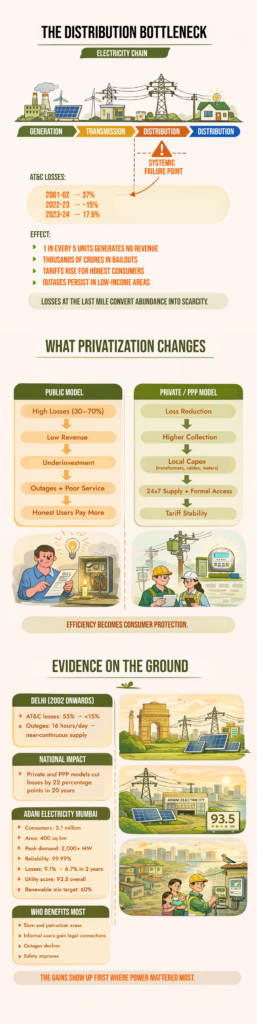
- India’s power problem is no longer generation. It is the last mile, where inefficiency turns electricity into scarcity.
- Private distribution works because it converts losses into service, making reliability affordable rather than exceptional.
- When regulated well, private grids deliver the most people-first outcome in the sector: dependable power for those who paid the highest price for failure.